Romance novels are such an entertaining read when done well. The problem is that it’s hard to find one that is decently written. There may be countless romance authors and twice as many romance novels, but quantity doesn’t equal quality.
Most romances I pick up are bad. Not in a funny way, not guilty-pleasure bad, just poorly written. I’m sorry to be so blunt, but it’s the truth. And I’m not the type of reader who can digest any type of content. It needs to be a certain quality in order for me to enjoy it. I’m not asking for a masterpiece, but at least provide some value. Have a captivating plot that’s also well-written. Have interesting characters that evolve throughout the book. Write mature dialogue that’s believable and doesn’t make me cringe. That sort of thing.
I’ve approached a similar subject a few years ago, gathering pros and cons as to why some people hate romance novels, while others love them. But that’s on a more general note and my frustration with this genre (or what authors have made of it) wasn’t so prominent back then.
Below, I’ll dive into the 5 things I hate the most about romance novels.
Author narrates unimportant events/activities
One of the main aspects that drives me crazy in many romance novels is the author’s insistence on narrating unimportant, mundane activities as if they matter. This is something I see over and over, especially in newer romances and contemporary romance or YA (as opposed to historical romance, where the writing style is usually more elevated). The book will pause the plot so the characters can go to a bar, for example, where nothing relevant happens: no tension, no shift in dynamics, no conflict, no meaningful conversation. Just… filler. And not even entertaining filler.
It makes the books feel childish, like the author is transcribing the characters’ day minute-by-minute, instead of writing a story that actually moves.
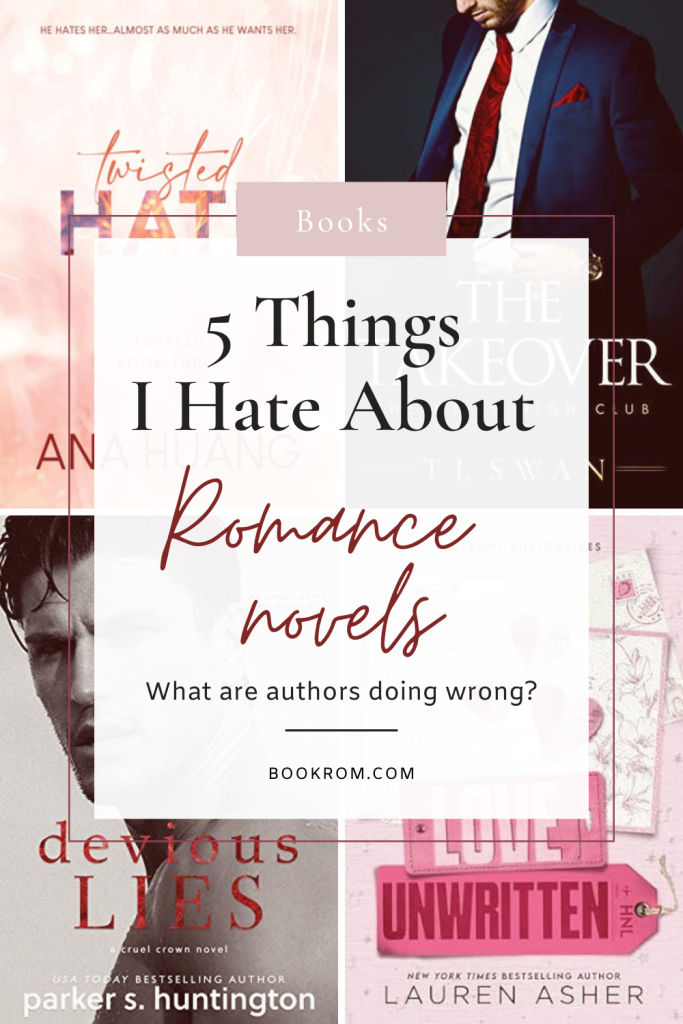
Twisted Hate by Ana Huang is a good example of this problem. It’s an enemies-to-lovers romance between a young woman who’s on her way to becoming a lawyer and a young man who’s a doctor and also the heroine’s best friend’s brother. It’s supposed to be filled with banter, and you’re supposed to feel the hate and the tension between the two characters, but I felt a big nothing. No tension, no hate, no chemistry. I couldn’t even keep my interest alive because there wasn’t anything making me want to know more or feel more. The author kept narrating the most uninteresting events.
And when something did have potential, the delivery was so flat and uninspired that it killed the moment entirely. Like reading a grocery list. You don’t feel anything when reading a grocery list, right? Well, neither do I when I read most of these novels. Except boredom and frustration, which of course come from unfulfilled expectations.
Childish dialogue
Have you read a mafia romance where the big alpha bosses have lines and conversations that made you cringe? Doesn’t it feel like the author is writing something they know nothing about and didn’t even bother to research? And I’m not talking only about mafia books here, this is just an example. I think the dialogue in a book is one of the aspects that tells the most about an author’s maturity and their capability to make the fictional world they’re trying to create believable.
Here are some examples:
- Tough guy who talks like a 12-year-old trying to sound scary. It usually sounds like he’s threatening someone with the emotional depth of a middle-schooler. And another problem here is that he’s trying way too hard to perform “dangerous” instead of being dangerous. This is the “show us, don’t tell us” rule authors should be following.
- Mafia boss who speaks in meme language.
- “Alpha” man who has zero emotional vocabulary.
- Zero research into actual organized crime. What they do, how they operate, etc.
- Fake “dangerous man” who constantly pouts.
- Mafia boss using cheesy pet names EVERY sentence. Like “baby girl”, “sugarplum”, “doll”.
Author tries too much to make a character seem original
Something else I hate about romance novels is when the author tries too hard to make a character stand out. You know when a character has these original lines and jokes that are supposed to make them quirky and different? This is a subjective thing, and while someone may find a character trait or line as being natural and effortless, I find it forced and in your face.
Here are some typical overdone character quirk/originality attempts that often backfire:
- Over-the-top “quirky” dialogue or personality traits. E.g., a heroine claiming “I’m totally not like other girls,” or spouting constant jokes, snark, unique catchphrases, or one-liner humor. Why does it feel forced? Because it draws attention to itself. Instead of feeling like a natural part of their personality, it feels like “look how different I am!” on parade.
- “Unrealistic uniqueness” combined with clichés. E.g., a heroine described both as “quirky” and “drop-dead gorgeous,” “different from everyone else,” yet still the most desirable, like the heroines in Twisted Hate by Ana Huang and Devious Lies by Parker S. Huntington. It stacks tropes instead of creating depth, making the character feel like a formula rather than a person.
- Forced “vulnerable but tough” backstory + edgy behavior: trauma, dark past, emotional baggage, and special “edge,” often used to justify attitude, overreactions, or melodramatic decisions. Instead of adding depth, it becomes an excuse to swing between extremes, often without believable growth.
Authors reusing the same stock phrases
I’m the type of reader who puts value into how an idea is delivered. Words matter, because words make you feel. The way an author uses words to describe emotions or a landscape. How an event is set into motion. Some authors have their unique way with words, while others abuse the same stock phrases that have become void of meaning at this point. One author who usually gets it right and whose clichés I can forgive because she brings originality and depth is Mia Sheridan. When you pick up one of her books, you know you’re in for an emotional ride.
Here are some of the most overused ones across romance, YA, fantasy-romance, and contemporary romance:
Overused Emotional / Physical Reaction Clichés:
- “She released the breath she didn’t realize she’d been holding.”
- “Her heart skipped a beat.” (Or “my heart stuttered in my chest.”)
- “Butterflies exploded in her stomach.”
- “Her pulse roared in her ears.”
- “His breath hitched.”
- “Her knees went weak.”
- “Heat pooled low in her belly.”
- “A shiver ran down her spine.”
- “Her cheeks warmed.” (Or “heat flooded her cheeks.”)
- “Their lips crashed together.”
- “She chewed her lip.” / “He ran a hand through his hair.”
(These are everywhere.)
Internal Monologue Clichés:
- “I didn’t come here to fall for him.”
- “What was wrong with me?”
- “This shouldn’t be happening.”
- “I shouldn’t want him. But I do.”
- “It was only supposed to be one night.”
- “I’m not like other girls.”
- “He was everything I shouldn’t want.”
Character Description Clichés:
- “His eyes darkened.”
- “His jaw ticked.”
- “Her stomach flipped.”
- “She felt something inside her break/open/unravel.”
- “He smirked.” (Used 100x per chapter sometimes.)
- “His voice dipped an octave.”
- “Electricity shot through her at his touch.”
- “Their eyes locked across the room.”
The stereotypical bombshell characters
Big boobs, big ass, tiny waist, drop-dead gorgeous, out-of-this-world beautiful…what else? It appears that romance novels frequently rely on a checklist of physical traits to signal “sexiness” or “ultimate romantic desirability”. Even books that supposedly feature diverse body types are often still forced into “ideal” shapes: curvy but proportioned just right.
Authors who promote their books as “diverse”, “modern”, or “edgy” still often fall back on this idealized “bombshell body” as the default attractiveness marker. One such book is Twisted Hate by Ana Huang, where the heroine is a drop-dead gorgeous, voluptuous redhead who’s the human equivalent of Jessica Rabbit.
But let’s be clear about something. The reason these aspects annoy me in romance novels is that they show a lack of originality and the author’s desperation to push an idea on me. To convince me that the characters are sexy and to imply that because the characters are sexy, I should feel the chemistry. As if their body description makes up for poor writing. The sexiness is implied, hence I have to feel it just because.
Why did I mention that? Because I want to be clear: my frustration has nothing to do with moral debates or body-positivity discourse. I’m not triggered by idealized beauty. I’m frustrated with authors who can’t come up with a truly unique character, yet spend pages obsessing over how attractive they supposedly are.
Anyway, to conclude this point, what annoys me isn’t the existence of beautiful characters (in fact, I do prefer to read about beautiful characters – and the thing is, in my mind, all the characters are beautiful or interesting when the authors allow me to envision them as I feel). What bothers me is the lack of originality and the sense that the author is trying to strong-arm me into feeling an attraction they didn’t actually build on page.
At the end of the day, I don’t hate romance as a genre. I hate what so many authors have reduced it to. Romance can be emotional, engaging, sharp, and genuinely fun to read, but only when there’s actual craft behind it. I’m not asking for perfection; I’m asking for intention, originality, and effort. If you want me to believe in your characters and their love story, then give me something worth believing in. Until then, I’ll keep searching for the rare romance novels that actually respect the reader and make the genre worth defending.